A CPA-firm site that makes a high-trust service feel modern — and proves its value with real tax math.
What a great insurance agency website needs in 2026
The short answer
A great insurance agency website removes fear of the unknown. Visitors arrive unsure about coverage and cost, so the site leads with a clear quote path, explains each policy line in plain words, and proves the agency is licensed, local and human before asking for anything.
By Nikolai Bhend · Updated September 2, 2026 · Audited to WCAG 2.2 AA
What the best insurance websites do in 2026 — the practices this template is built to prove.
The demo is the evidence
Shield Insurance Group — a fictional insurance agency in Austin, TX — is this template running live at insurance.horizonstemplates.com. Primary action: “Get a free quote”. Load it right here, flip it to mobile, or open it full-size.
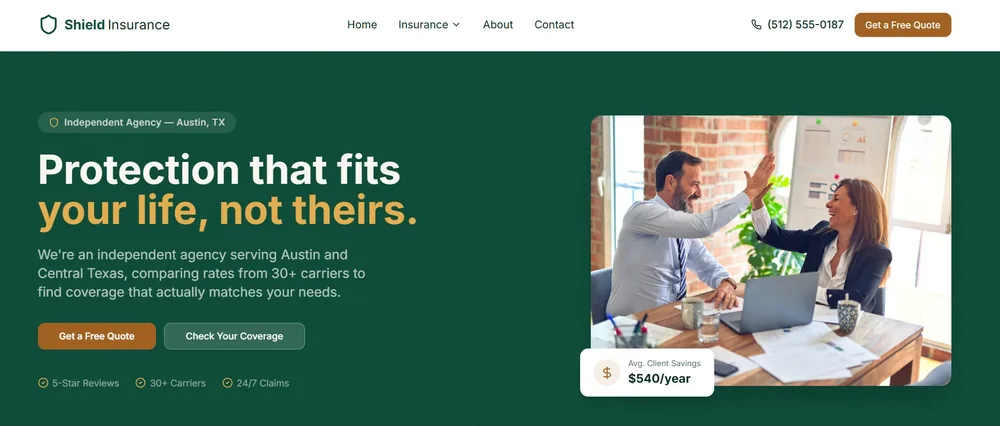
Free to make yours: on the demo, choose Use template in the Hostinger bar at the bottom of the page — it starts you from this exact build in Hostinger Horizons. Publishing the finished site needs a Horizons plan; this directory charges nothing.
What does a great insurance agency website need in 2026?
It needs to orient a risk-averse visitor in seconds: who you help, which lines you write, where you operate, and how to reach a real person. Insurance buyers judge whether an agency feels competent and safe long before they compare coverage details, so clarity is the conversion strategy.
The template answers all four in the first screen, keeps the quote action visible at every scroll depth, and writes every coverage line in plain language rather than industry jargon.
Why lead with a quote builder instead of a contact form?
Because the industry has moved to permissionless lead capture: guided, step-through quote flows let visitors self-qualify before they ever talk to an agent, and conversational intake converts measurably better than a long multi-field form.
The demo ships that flow working end to end — with a consent checkbox written to the current TCPA standard, where contact consent is explicitly not a condition of purchase and the privacy policy is one tap away.
Which pages does an insurance site actually need?
Five answer-shaped coverage pages — auto, home, life, business and health — plus a privacy policy and terms shaped to GLBA and state privacy law, a licensing disclosure, and an about page with named people. A posted privacy policy is not optional: most privacy laws require one wherever personal information is collected.
Each coverage page opens with a direct answer to the question the visitor actually searched, then explains who the line is for and what affects cost.
How does the template handle trust without fake reviews?
With verifiable substance: named agents carrying real industry designations, a licensing disclosure line, financial-grade legal pages, and three advice articles whose credentialed bylines match the about page and the Person schema. Specific, checkable credibility beats invented star ratings — and fabricated proof is a liability, not a shortcut.
Is it accessible and fast enough for a form-heavy site?
Yes — audited to WCAG 2.2 AA across contrast, focus visibility, target sizes and form labelling, with lightweight CSS-only motion and no heavyweight dependencies. Speed and accessibility are trust signals in a category where visitors are about to hand over personal information.
How hard is it to make this template yours?
A rebrand is data entry, not development: the agency name, lines, licence numbers and legal details live in a single source that every page reads. Swap the brand, point the quote flow at however you already intake leads, and the structure, schema and accessibility work carry over unchanged.
What we shipped and measured
First-party specifics from this build and its four audits — not marketing claims. Every item is visible in the live demo.
- 5 plain-language coverage pages — auto, home, life, business, health
- Step-through quote builder with a TCPA-correct consent gate
- GLBA-shaped privacy + terms, plus a licensing disclosure block
- 3 advice articles by named, credentialed authors (CPCU, CIC, CISR, CRM)
- Person schema matched to visible bios — no fabricated reviews anywhere
- 4 sequential audits · WCAG 2.2 AA verified
Questions
Yes. It ships with five coverage pages — auto, home, life, business and health — each written in plain language rather than policy jargon. The structure scales to as many or as few lines as your agency actually writes: add, rename or remove a line and the navigation, pages and structured data all follow from the same source.
It works end to end in the demo and shows a clean success state, so you can walk the whole path a prospect would. In your own build you point it at however you already intake leads — an agency management system, a CRM, or an email inbox — without changing the layout or the consent wording.
The demo models current TCPA-correct consent: the checkbox is unchecked by default, contact consent is explicitly not a condition of purchase, and the privacy policy is linked at the point of consent. Rules vary by state and by line, so have your own counsel confirm the exact wording before you go live.
Your agency name and licence details, the coverage lines you write, your service area, and the named agents with their real designations. Contact details ship as obvious placeholders so nothing fake goes live by accident. The advice articles are yours to rewrite or remove; everything else is structure you can keep.
Ready to build your insurance agency site?
Open the live demo, walk through it like a customer, then make it yours.