A seasonal restaurant site where the menu is the star — filterable, accessible, and honest about provenance.
What a great café / roastery website needs in 2026
The short answer
A great café website sells atmosphere before product. People choose a coffee shop on feeling, so the site leads with mood and place, answers the two questions that decide a visit — are you open, where are you — instantly, and treats the menu like a board, not a spreadsheet.
By Nikolai Bhend · Updated September 2, 2026 · Audited to WCAG 2.2 AA
What the best café websites do in 2026 — the practices this template is built to prove.
The demo is the evidence
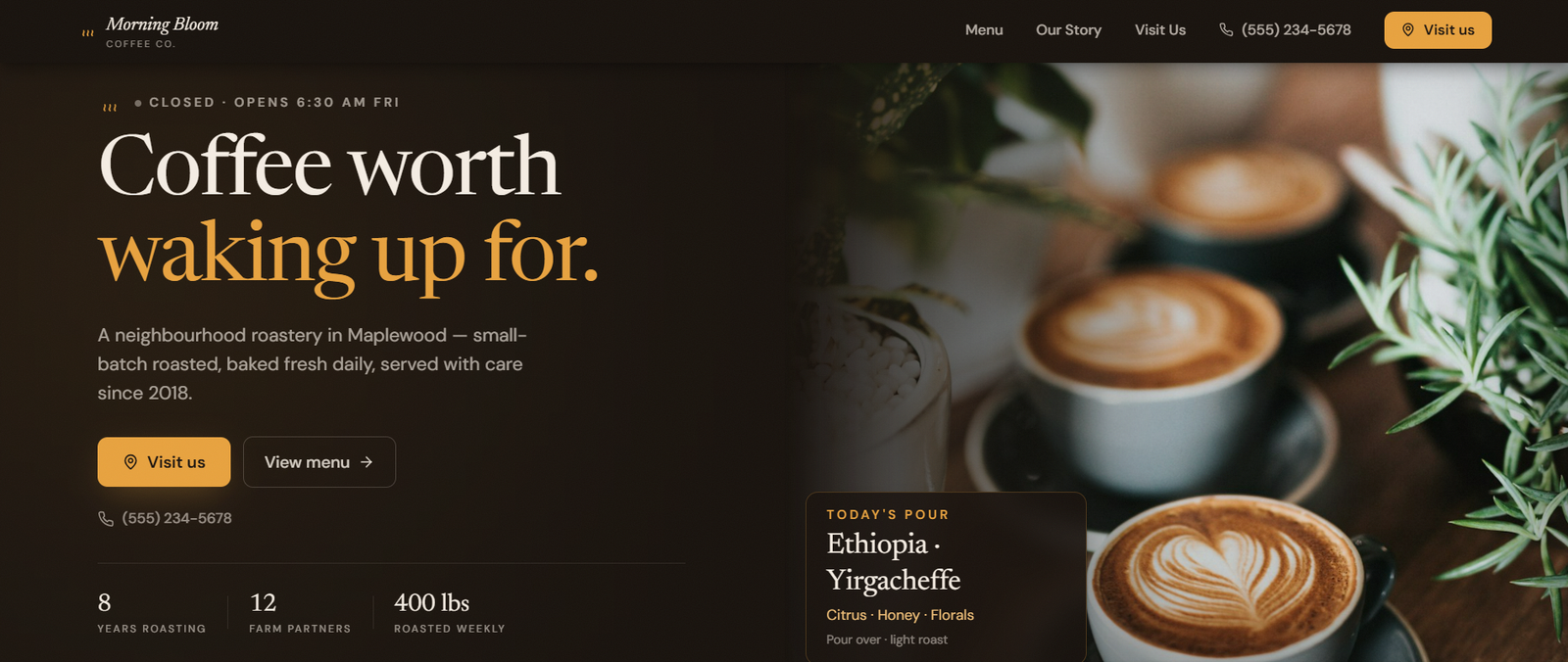
Morning Bloom Coffee — a fictional café / roastery in Maplewood, NJ — is this template running live at coffee.horizonstemplates.com. Primary action: “See the menu”. Load it right here, flip it to mobile, or open it full-size.
Free to make yours: on the demo, choose Use template in the Hostinger bar at the bottom of the page — it starts you from this exact build in Hostinger Horizons. Publishing the finished site needs a Horizons plan; this directory charges nothing.
What does a great café website need in 2026?
It needs to answer four questions before the visitor scrolls: are you open, where are you, what do you serve, and what makes you different. Most people decide where to get coffee after a quick glance at a phone, so the homepage is a filter, not a design statement — clarity wins.
The template leads with place and mood, keeps a single clear action and a tap-to-call number in reach, and states three specific differentiators — house-roasting, sourcing, a signature bake — rather than a generic "we love coffee."
Why compute open/closed live instead of just listing hours?
"Are you open right now" is the single most-checked fact on any café site, and a static hours table forces the visitor to work it out — then punishes any holiday exception with a wasted trip.
The demo computes an open or closed status pill from the stated opening hours in real time. Update your hours and the status logic follows automatically, so the answer is always current.
Should the menu be a PDF or a web page?
A web page, always. A downloadable PDF loads slowly on mobile, pinches awkwardly, cannot be copied, and is invisible to search — the fastest way to lose a phone-holding visitor in 2026.
The template ships the menu as native content — espresso, filter and pastries the way a café board reads — with prices next to every item and allergens flagged clearly, structured so a price change is a one-line edit.
Why does the hero animate, and is that a performance cost?
Atmosphere is the product a café sells, so the hero earns a little motion — but not at the cost of speed or access. The living-steam effect is built in pure CSS with no animation library, and it is gated behind reduced-motion preferences so it never plays for visitors who ask the system to reduce motion, and never blocks the page.
How does the roastery story build trust?
By being specific. Customers who care about craft want provenance — where the beans come from and how they are roasted — told plainly, and specificity is what separates a credible independent from a generic chain. The section is structured to feature retail beans, so a commerce layer drops in cleanly when you are ready to sell them.
Is it accessible, fast, and simple for an owner to update?
Yes to all three: audited to WCAG 2.2 AA, deliberately lightweight with CSS-only motion, and driven from structured content so rebranding is data entry. Change the name, hours, menu and roast story in one place, and the status pill, menu and schema all follow.
What we shipped and measured
First-party specifics from this build and its four audits — not marketing claims. Every item is visible in the live demo.
- Live open/closed status pill computed from real opening hours
- Living-steam hero in pure CSS — no animation library, reduced-motion gated
- Native menu with prices and clear allergen flags — no slow PDF
- Roast-provenance section structured to feature retail beans
- Tap-to-call and address in thumb reach on every screen
- 4 sequential audits · WCAG 2.2 AA verified
Questions
The roast section is structured to feature retail beans with origin and roast detail, so adding a commerce layer in your production build is a natural extension rather than a rebuild. The demo itself stays deliberately transactional-free: it is built to get someone through your door.
They are data. The open-or-closed status pill reads your stated hours live, so updating your hours updates the status logic at the same time. That matters because "are you open right now" is the most-checked fact on any café site, and a stale answer costs you a visit.
The menu is structured content rather than an image or a PDF, so a price change is a one-line edit that updates the page immediately. Allergens are flagged per item in the same place, which keeps the information accurate instead of drifting out of date on a printed board.
No. The living-steam effect is built entirely in CSS with no animation library, so it adds atmosphere without a JavaScript payload, and it is switched off automatically for visitors whose system asks for reduced motion. Speed matters here: most café visits start with a quick phone search.
Ready to build your café / roastery site?
Open the live demo, walk through it like a customer, then make it yours.