A calm, modern practice site built to move a nervous patient from hesitation to a booked appointment.
What a great med spa website needs in 2026
The short answer
A great med spa website balances medical credibility with aspiration. Clients need to feel results are safe and the experience is considered, so the site pairs a calm, premium aesthetic with real treatment depth, named medical oversight, and a finder that shortens the path from concern to consultation.
By Nikolai Bhend · Updated September 2, 2026 · Audited to WCAG 2.2 AA
What the best med spa websites do in 2026 — the practices this template is built to prove.
The demo is the evidence
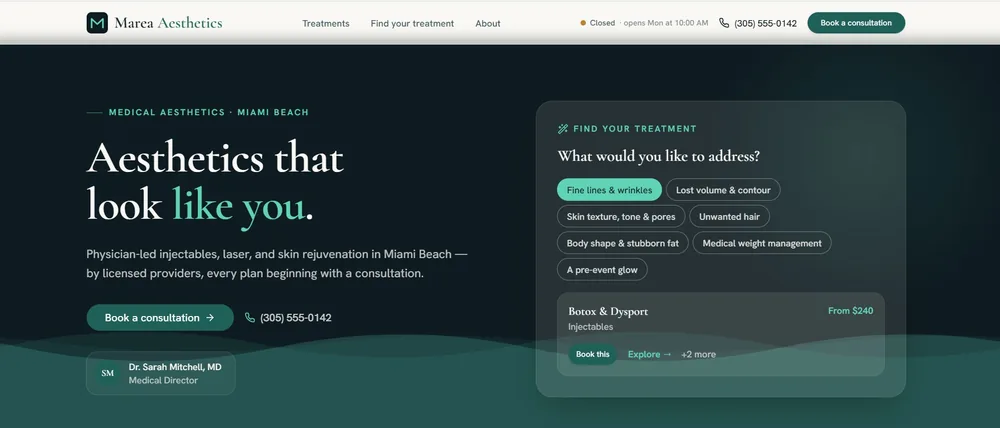
Marea Aesthetics — a fictional med spa in Miami Beach, FL — is this template running live at medspa.horizonstemplates.com. Primary action: “Book a consultation”. Load it right here, flip it to mobile, or open it full-size.
Free to make yours: on the demo, choose Use template in the Hostinger bar at the bottom of the page — it starts you from this exact build in Hostinger Horizons. Publishing the finished site needs a Horizons plan; this directory charges nothing.
What does a great med spa website need in 2026?
It has exactly one job: convert interest into a booked consultation, and it does that by building trust and reducing uncertainty faster than a competitor. Aesthetic decisions are emotional and time-sensitive, so the patient should never be more than one tap from booking — a self-test is whether you can book in under fifteen seconds on your own phone, on cellular.
The template pairs a calm, premium aesthetic with real treatment depth and named medical oversight, and keeps consultation booking reachable from every screen.
Why a treatment finder instead of a services menu?
Because visitors need suitability guidance before they need persuasive copy — the question in their head is "which treatment is even right for me?", and a treatment page that only showcases benefits leaves that unanswered.
The demo embeds an ungated concern-to-treatment finder in the hero that routes each visitor to the right treatment and deep-links into booking with the choice prefilled. It reduces uncertainty, which is what actually raises consultation quality and conversion.
Why is the primary action a consultation, not a treatment?
Because a good-faith medical exam is required before treatment in this category, so the honest, compliant journey is consultation-first. Modelling anything else would misrepresent how a real clinic must operate.
The template treats "Book a consultation" as the single primary action, present on every screen, and sets expectations about what that consultation involves — pre-booking expectation-setting is what makes the funnel convert at a higher quality level.
How does the hero move without hurting speed or access?
The Living Tide hero uses layered CSS wave motion — no animation library — so it adds atmosphere without a heavy JavaScript payload, and it is gated behind reduced-motion preferences so it never plays for visitors who ask the system to reduce motion. Speed matters: the best med spa sites load in under about two and a half seconds, because every second of delay bleeds emotional, time-sensitive bookings.
How does it prove medical credibility honestly?
With named people and real substance rather than fabricated proof. A named medical director and providers appear in visible bios and matching schema, treatment pages carry candidacy guidance and real FAQs, and before/after results — which genuinely drive bookings — are handled with a consent-gated slot that stays empty until real, consented cases exist.
That honesty is not just ethics: patient photos require written consent, and fabricated results would be a liability for a medical practice.
Is it accessible, fast, and easy to re-scope to my menu?
Yes — audited to WCAG 2.2 AA, deliberately lightweight, and driven from structured content. Treatments, providers and the finder's concern-to-treatment mapping live in one place, so rebranding and re-scoping to your own menu is data entry, and the booking action connects to whatever scheduling platform your clinic runs.
What we shipped and measured
First-party specifics from this build and its four audits — not marketing claims. Every item is visible in the live demo.
- Ungated concern-to-treatment finder that deep-links into booking, choice prefilled
- Living Tide layered CSS wave hero — no animation library, reduced-motion gated
- Consultation-first booking reachable from every screen
- Treatment pages: overview, candidacy guidance, real FAQs, matched schema
- Named medical director + providers; consent-gated before/after slot (stays empty)
- 4 sequential audits · WCAG 2.2 AA verified
Questions
Because a good-faith medical exam is required before treatment in this category, so consultation-first is the compliant journey a real clinic must run. Modelling anything else would misrepresent how the business works — and setting expectations before booking is also what raises consultation quality.
There are none. The demo ships a clearly-labelled, consent-gated slot instead of fabricated results, and you add real cases once you have written patient consent. Before-and-afters genuinely drive bookings, which is exactly why inventing them would be both a credibility risk and a legal one.
It is ungated — no email required. A visitor picks the concern they came for, the finder routes them to the matching treatment, and the booking link arrives with that choice already filled in. It answers "which treatment is right for me?" before persuasive copy is even needed.
Yes. Treatments, providers and the concern-to-treatment mapping all live in one place, so adding, removing or renaming a treatment updates the finder, the treatment pages and the structured data together. Provider photos are marked as swap-me slots with a clean fallback until you supply real ones.
Ready to build your med spa site?
Open the live demo, walk through it like a customer, then make it yours.