Evidence · Café / roastery · 8 practices verified live
What the best café websites do in 2026
The short answer
The best café websites in 2026 sell atmosphere first and answer the visit questions instantly: are you open right now, where are you, what do you serve, what makes you different. Most people decide where to get coffee after a glance at a phone, so the leaders keep the page light, put the menu in HTML rather than a PDF, state their hours and location as data an engine can read, and tell the provenance story with specifics. Each practice below is checked against a live template built to prove it.
By Nikolai Bhend · Verified against the live template · Updated September 2, 2026
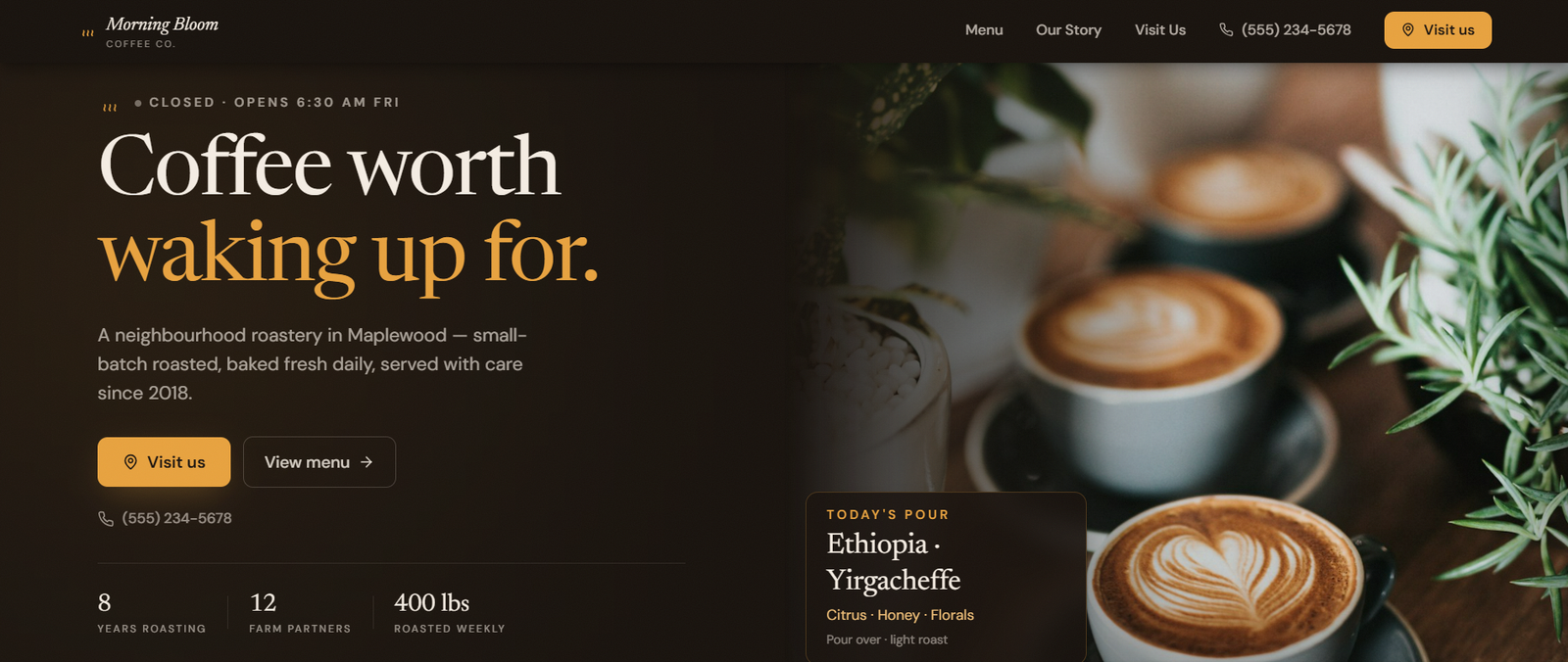
Morning Bloom Coffee — the café / roastery template behind this page, a fictional business in Maplewood, NJ, running live at coffee.horizonstemplates.com. Every claim below was checked on it.
The 8 practices, verified live
What the category leaders ship, and where this template proves each one. Each card jumps to the detail.
- 01“Are you open right now?” answered liveVerified live
- 02The menu as a web page, with prices and dietary flagsVerified live
- 03The visit questions, answered in a real FAQVerified live
- 04Say what you are in one sentence, with numbers you can stand behindVerified live
- 05One identity everywhere: name, address, phone, hours, in the data tooVerified live
- 06Atmosphere first, at no cost to speedVerified live
- 07Call and directions in thumb reach on every screenVerified live
- 08Provenance told with specifics, ready for retailVerified live
- 01
“Are you open right now?” answered live
What the best café sites do
It is the single most-checked fact on any café site, and a static hours table makes the visitor work it out — then punishes every holiday exception with a wasted trip. The leaders compute it, and publish the same hours as structured data so map and answer engines agree with the page.
What Morning Bloom Coffee ships · verified live
Morning Bloom Coffee computes an open-or-closed status pill from the stated opening hours in real time, and the same hours feed the opening-hours schema. Update the hours once and both follow.
See the live status pillMake it yours
Your hours — once.
- 03
The visit questions, answered in a real FAQ
What the best café sites do
Parking, transit, plant milks, vegan and gluten-free options, work-friendliness, reservations: these are the “near me” questions people actually ask, and the leaders answer them in visible, answer-first Q&A mirrored exactly in FAQ schema — which AI engines now treat as a primary extraction source.
What Morning Bloom Coffee ships · verified live
Morning Bloom carries eight answer-first questions on the page — location and parking, hours, plant milks, dietary options, in-house roasting, retail and wholesale beans, working from the café, reservations — with FAQ schema kept byte-identical to the visible text.
Read the FAQMake it yours
Your answers — each one is a swap-me default.
- 04
Say what you are in one sentence, with numbers you can stand behind
What the best café sites do
Engines extract entities from plain definitions: “X is a Y in Z.” The leaders open their story with that sentence and surface a few citable specifics — how much they roast, how many farms they buy from — as facts rather than adjectives.
What Morning Bloom Coffee ships · verified live
The demo’s about section opens with the entity-defining sentence and states its specifics plainly — roughly four hundred pounds roasted a week from twelve farm partners — pulled from one data source so they are stated once and never contradict.
Read the about sectionMake it yours
Your one-sentence definition and your real numbers.
- 05
One identity everywhere: name, address, phone, hours, in the data too
What the best café sites do
Exact, identical name, address and phone across the site, the business profile and directories — “St” versus “Street” matters — plus café schema with opening hours, price range, cuisine, service area and coordinates. Around four in five café searches are non-branded, so the local entity is the whole game.
What Morning Bloom Coffee ships · verified live
The template drives name, address and phone from one source into the page, the schema and the no-JS fallback, and its café schema carries opening hours, price range, cuisine, a five-town service area, coordinates, founders and profile links.
Check the find-us stripMake it yours
Your details — once, in one place.
- 06
Atmosphere first, at no cost to speed
What the best café sites do
People choose a coffee shop on feeling, so the leaders lead with mood and place — but never with a heavy animation library or a hero that delays the page. Motion is earned, light, and switched off for visitors who ask their system to reduce it.
What Morning Bloom Coffee ships · verified live
The living-steam hero is pure CSS with no animation library, gated behind the reduced-motion preference, and the page stays light enough for a phone on the pavement.
Open Morning Bloom CoffeeMake it yours
Your palette and photography; the motion needs no change.
- 07
Call and directions in thumb reach on every screen
What the best café sites do
The five-second job on a café site is getting there: the leaders keep tap-to-call and directions one tap away at every scroll depth on a phone, without covering the content.
What Morning Bloom Coffee ships · verified live
The template keeps a tap-to-call number and the address in reach on every screen, with a mobile sticky bar carrying Call and Directions, guarded so it never covers the footer or a focused element.
Open the demo on your phoneMake it yours
Your number and address — one place.
- 08
Provenance told with specifics, ready for retail
What the best café sites do
Customers who care about craft want to know where the beans come from and how they are roasted, told plainly; specificity is what separates a credible independent from a chain. The best sites structure that story so retail beans can be sold from it later.
What Morning Bloom Coffee ships · verified live
The roast-provenance section is structured to feature retail beans with origin and roast detail, so a commerce layer drops in cleanly when you are ready — while the demo itself stays focused on getting someone through the door.
Read the roastery storyMake it yours
Your origins, your roast notes, your beans.
Morning Bloom Coffee · Maplewood, NJ
See every practice live: Morning Bloom Coffee
The café template behind this page ships each practice above as a working, audited build — walk the real thing, then make it yours. Cloning is free; publishing needs a Hostinger Horizons plan.
Questions people ask
The four visit answers: whether you are open right now, where you are, what you serve and what makes you different — plus a tap-to-call number. Everything else can scroll. Most people decide from a phone in a few seconds, so the homepage is a filter, not a design statement.
No. A PDF is slow on mobile, awkward to read, cannot be copied, and is invisible to search and AI engines. Publish the menu as a web page with prices and dietary flags, and mirror it in menu schema so engines can read it too.
More than before. Google retired the dropdown in search results in May 2026, but FAQ schema has become a primary way AI answer engines extract Q&A — provided the markup mirrors real, visible questions and answers on the page, and the answers are substantive rather than one-liners.
Both, and they must agree. The business profile, its reviews and local mentions are the dominant local ranking levers; the website’s job is to reinforce them with an identical name, address, phone and hours, a real HTML menu, answer-shaped FAQs and clean schema — so every engine tells the same story.
More evidence pages
- Dental clinicWhat the best dental websites do
- Law firmWhat the best law firm websites do
- PlumbingWhat the best plumbing websites do
- Insurance agencyWhat the best insurance websites do
- Real estateWhat the best real estate websites do
- RestaurantWhat the best restaurant websites do
- Med spaWhat the best med spa websites do
- AccountingWhat the best accounting websites do
- Hair salonWhat the best hair salon websites do