Evidence · Law firm · 8 practices verified live
What the best law firm websites do in 2026
The short answer
The best law firm websites in 2026 meet a stressed, skeptical visitor with orientation rather than bravado. They help the visitor work out what kind of problem they have, show that the firm is genuinely regulated and transparent about pricing, name the people with their real credentials, answer the questions clients actually ask, and offer one dignified way to start a conversation. Each practice below is checked against a live template built to prove it.
By Nikolai Bhend · Verified against the live template · Updated September 2, 2026
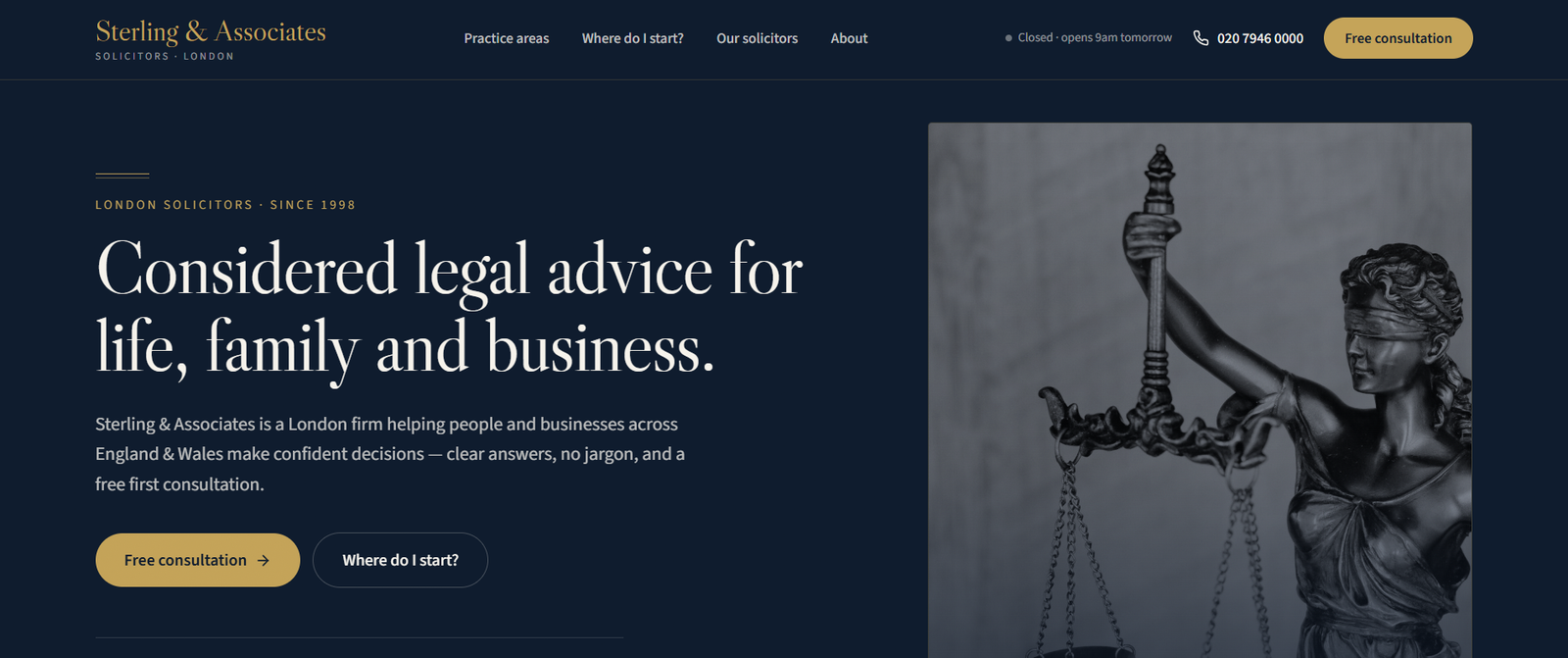
Sterling & Associates — the law firm template behind this page, a fictional business in London, UK, running live at law.horizonstemplates.com. Every claim below was checked on it.
The 8 practices, verified live
What the category leaders ship, and where this template proves each one. Each card jumps to the detail.
- 01Orientation before persuasion: help the visitor name their problemVerified live
- 02Practice-area pages that answer real questions — with FAQ markupVerified live
- 03Regulator, complaints route and pricing shown as a feature, not fine printVerified live
- 04Named lawyers with verifiable credentialsVerified live
- 05One dignified way to start a conversationVerified live
- 06Mobile-first and under three secondsVerified live
- 07Testimonials and results only where they are real and permittedVerified live
- 08Built to retarget: compliance and practice areas as dataVerified live
- 01
Orientation before persuasion: help the visitor name their problem
What the best law firm sites do
The hardest moment for a potential client is not choosing a firm — it is working out what kind of matter they even have. High-converting legal sites replace the wall of practice areas with a guided “how can we help” entry point, and at least one genuinely useful interactive tool is now what separates them from digital brochures.
What Sterling & Associates ships · verified live
Sterling & Associates ships a guided matter navigator: describe the situation, get routed to the right practice area and a clear next step. It turns the most uncertain moment of the journey into the easiest one.
Try the matter navigatorMake it yours
Your practice areas and the situations that lead to each.
- 02
Practice-area pages that answer real questions — with FAQ markup
What the best law firm sites do
The pages that rank and get quoted answer the questions a client actually asks about that matter, in plain language, and mark them up with FAQPage schema — the structure search and AI engines lift into summaries and zero-click results.
What Sterling & Associates ships · verified live
Every practice-area page on the template carries an answer-shaped FAQ marked up with FAQPage schema, so the visible answers and the structured data are the same text.
Open a practice-area pageMake it yours
Your areas, your questions, your answers.
- 03
Regulator, complaints route and pricing shown as a feature, not fine print
What the best law firm sites do
Regulated firms are required to state who regulates them, how to complain, and — for the services the rules name — what things cost. The best sites treat that as trust content and keep it consistent everywhere; the worst hide it in a footer link that contradicts the pricing page.
What Sterling & Associates ships · verified live
The template drives regulator identity, the complaints procedure and mandated price-transparency information from a single compliance source, so the authorisation line, the complaints route and the pricing stay consistent across the site. The demo models England and Wales with SRA-shaped compliance; the pattern is a data change for any other regulator.
See the compliance blockMake it yours
Your regulator, registration number, complaints route and price information.
- 04
Named lawyers with verifiable credentials
What the best law firm sites do
A bio that calls someone “a passionate advocate” does nothing for trust or for AI visibility. Leaders publish admissions, specific experience and real qualifications for each named lawyer, and attribute practice pages to them, so expertise is verifiable by a person and by an engine.
What Sterling & Associates ships · verified live
Sterling & Associates carries named solicitor bylines on practice pages, matched to Person schema with credentials — the same names and qualifications in the visible bio and in the structured data.
Meet the named solicitors on the demoMake it yours
Your people, their admissions and qualifications.
- 05
One dignified way to start a conversation
What the best law firm sites do
Legal clients are wary. The best sites offer a single, clearly-labelled first step — a consultation or a call back — with a phone alternative and no aggressive pop-ups or countdown pressure, and they say what happens after the form is sent.
What Sterling & Associates ships · verified live
The template keeps one dignified consultation path as the only primary action across the site, so a visitor is never asked for anything before they know where they stand.
See the consultation pathMake it yours
Your intake channel and response-time promise.
- 06
Mobile-first and under three seconds
What the best law firm sites do
Well over half of legal enquiries now start on a phone, and visitors judge a firm in seconds. A fast, mobile-first site is table stakes, not polish — and a slow one reads as a slow firm.
What Sterling & Associates ships · verified live
The template is mobile-first and deliberately lightweight, audited to WCAG 2.2 AA, with a single primary action that stays reachable on a phone.
Open the demo on your phoneMake it yours
Nothing — keep it light when you add your content.
- 07
Testimonials and results only where they are real and permitted
What the best law firm sites do
Client stories and “results” are regulated: in England and Wales they must not mislead, and several US bars restrict outcome claims outright. The leaders publish only real, consented quotes within their rules; the rest invent them and pay for it in trust.
What Sterling & Associates ships · verified live
The template ships no invented client stories or outcome claims. Any testimonial slot stays empty until you have a real, consented quote and your regulator’s rules allow it.
See how the demo handles proofMake it yours
Real, consented client quotes — only if your rules permit them.
- 08
Built to retarget: compliance and practice areas as data
What the best law firm sites do
A firm site is rebuilt far too often because jurisdiction and regulation are hard-coded into copy. The best implementations keep regulator, disclosures and practice areas as data so a merger, a new office or a rule change is an edit, not a project.
What Sterling & Associates ships · verified live
Because compliance is single-sourced and the matter navigator routes to whatever practice areas you define, retargeting the template to your regulator and areas is a data change, not a rebuild — from a two-person boutique to a multi-specialty firm.
Open Sterling & AssociatesMake it yours
Your jurisdiction, your regulator, your areas — data, not code.
Sterling & Associates · London, UK
See every practice live: Sterling & Associates
The law firm template behind this page ships each practice above as a working, audited build — walk the real thing, then make it yours. Cloning is free; publishing needs a Hostinger Horizons plan.
Questions people ask
They orient before they persuade: a guided entry that helps the visitor name their matter, practice-area pages that answer real questions with FAQ markup, visible regulator and complaints information with transparent pricing, named lawyers with verifiable credentials, and one dignified path to a first conversation — all fast on a phone.
Where the rules require it, yes — in England and Wales the SRA Transparency Rules name the services that must carry price information, and elsewhere transparent pricing measurably reduces friction for wary clients. What matters is consistency: one source driving the pricing page, the footer and any practice page that mentions cost.
It depends on the regulator. Many permit real, consented client quotes that do not mislead; several US bars restrict claims about outcomes. The safe pattern is a template that ships no invented stories and gives you a slot to fill only when you have something real and permitted.
A short guided flow that asks what the visitor is dealing with and routes them to the right practice area and next step. It answers the question that stalls most legal enquiries — “what kind of problem do I even have?” — and it is the kind of genuinely useful tool that separates high-converting legal sites from brochures.
More evidence pages
- Dental clinicWhat the best dental websites do
- PlumbingWhat the best plumbing websites do
- Insurance agencyWhat the best insurance websites do
- Real estateWhat the best real estate websites do
- Café / roasteryWhat the best café websites do
- RestaurantWhat the best restaurant websites do
- Med spaWhat the best med spa websites do
- AccountingWhat the best accounting websites do
- Hair salonWhat the best hair salon websites do